All Stories

Value fashion retailers bet on regional expansion as V-Bazaar retail launches new stores

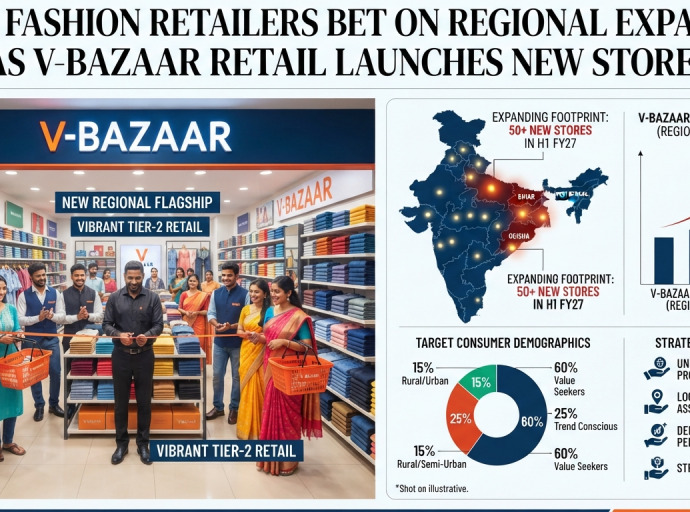
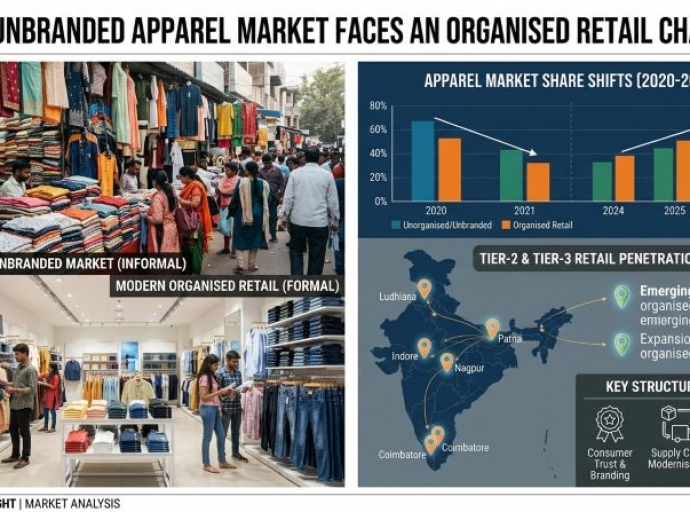
Regional fashion chains are accelerating store rollouts across India’s heartland to capture rising disposable incomes outside metropolitan centers. V-Bazaar Retail recently expanded its physical footprint past 130 outlets across 95 cities in six states, concentrating heavily on Tier II, III, and IV markets. As rural and semi-urban consumers increasingly favor organized retail over unbranded local markets, value apparel chains are competing aggressively on ticket-size incentives. Industry estimates suggest value fashion accounts for nearly 60 per cent of India's overall apparel market, prompting retailers to bundle household appliances with clothing purchases to drive higher footfall and defend gross margins against inflationary pressures.

Reducing marketing overheads with in-house automation

To sustain store-level profitability while scaling rapidly, retailers are restructuring creative production budgets. Rather than outsourcing high-cost festive shoots, V-Bazaar’s internal marketing unit deployed generative video software to produce localized promotional reels for ethnic and casual wear lines. Automating visual production allows our internal team to execute multiple regional styling concepts simultaneously without inflating customer acquisition costs, notes Raghav Agarwal, Director, V-Bazaar Retail. This approach reflects a broader sector trend where mid-sized apparel chains utilize automated content tools and ente What is fueling V-Bazaar Retail's rapid expansion across 95 Indian cities? Explore how value fashion brands capture non-metro demanrtainment partnerships to maximize return on ad spend during peak seasonal cycles.

Targeting consistent revenue growth with store additions

Founded in 2014, V-Bazaar Retail operates family-focused value fashion department stores across northern and eastern India, including Uttar Pradesh and Bihar. Specializing in affordable ethnic wear, western casuals, and general merchandise, the company targets consistent annual revenue growth through disciplined store additions and private-label margin expansion across underserved small-town catchments.

Value fashion retailers bet on regional expansion as V-Bazaar retail launches new stores

Apparel retailers stabilize store productivity with men’s ethnic wear expansion

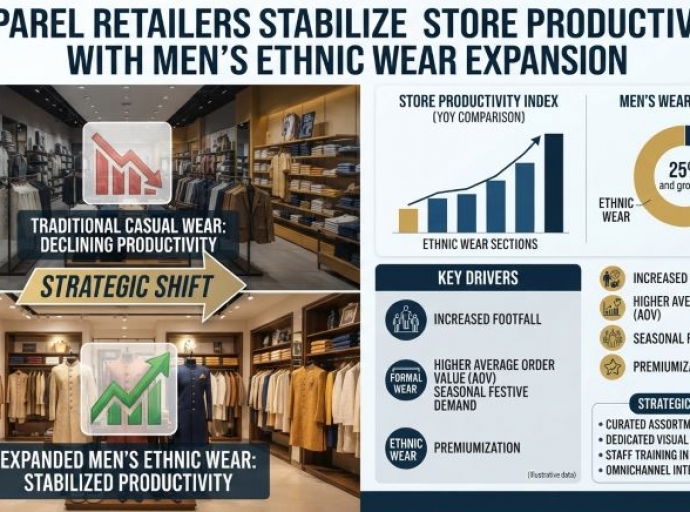
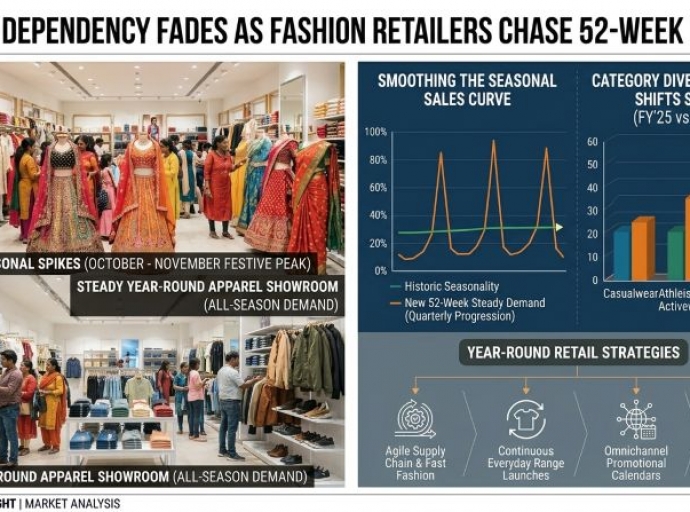
Indian apparel retailers are expanding men’s ethnic collections beyond wedding and festive calendars to stabilize year-round store productivity. While the domestic ethnic apparel sector reached Rs 2.4 lakh crore in 2024 and is projected to reach Rs 3.3 lakh crore by 2029, roughly 58 per cent of demand remains tied to celebrations. This concentration creates sharp quarterly revenue fluctuations; for instance, Vedant Fashions saw quarterly revenue drop 18.8 per cent between the wedding-heavy December 2025 quarter and the March 2026 quarter. Relying solely on auspicious wedding dates exposes retailers to inventory gluts and higher GST slabs on premium occasionwear, says Rohan Deshmukh, Retail Analyst, Mumbai.

MUCH MORE

Casual kurtas and Indo-Western silhouettes drive volume

To counter cyclical dips, legacy brands and new entrants are introducing breathable linen kurtas, knit bandhgalas, and understated separates priced under Rs 2,500 for office and weekend wear. Aditya Birla Fashion’s premium menswear label Tasva recorded 33 per cent quarterly growth in early 2026 by pairing contemporary tailoring with accessible everyday price points. Expanding into non-occasion categories allows apparel chains to improve inventory turnover and defend market share against fast-growing western menswear.

WATCH

Expanding everyday festive separates to sustain gross margins

Established in 1999 in Kolkata, Vedant Fashions operates leading celebration-wear brands including Manyavar and Twamev across 669 exclusive brand outlets globally. Targeting middle-to-premium domestic and diaspora consumers, the company is expanding into everyday festive separates and Tier-II cities to sustain its industry-leading 65.7 per cent gross margins.

Easitex-Textiles Sustainability

Apparel retailers stabilize store productivity with men’s ethnic wear expansion

Private labels boost Baazar Style Retail sales amid festive calendar shift

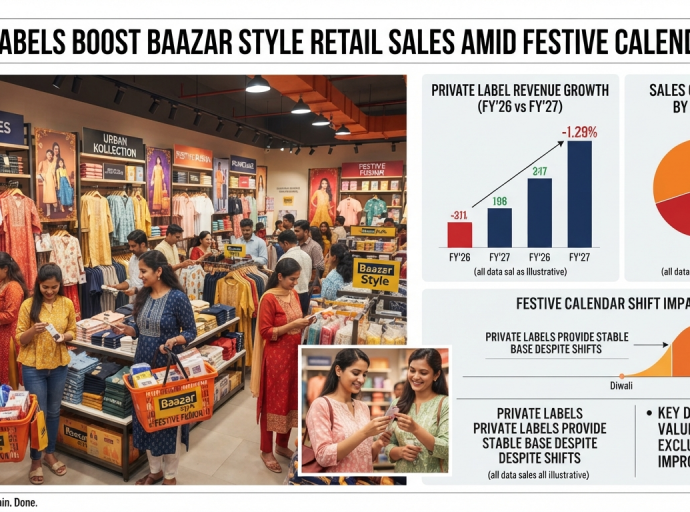
While a shifted festive calendar dampened second-quarter top-line figures across India’s value apparel sector, Baazar Style Retail strengthened its core merchandising mix during H1, FY27. Apparel accounted for 87 per cent of the brand’s half-yearly sales, with private labels = such as Square Up - rising 1.8 percentage points Y-o-Y to reach 61 per cent of total revenue. Management is now steering in-house brand contribution toward 65 per cent to protect gross margins, which held at 31.6 per cent in H1 FY27 despite Q2 revenue declined by 10 per cent to Rs 478.5 crore.

Scaling regional clusters toward 600 stores

Aggressive store additions weighed on near-term profitability, pushing Q2 into a Rs 32.1 crore net loss as monthly sales per square foot softened 14 per cent to Rs 660. However, total H1 units sold rose by 14.1 per cent to 39.4 million across 283 stores, expanding to 293 outlets by early November. Our cluster-based expansion strategy remains central to our growth approach, enabling us to build stronger regional presence and improve supply-chain efficiencies, stated Shreyans Surana, Managing Director. With festive demand moving into Q3, the retailer aims to offset store-maturation costs and capture rising semi-urban fashion consumption.

Eyeing Rs 5,600 crore turnover by FY29

Founded in Kolkata in 2013, Baazar Style Retail operates Style Baazar and Express Baazar stores across 10 states, focusing on Tier-III and Tier-IV apparel and general merchandise markets. Following H1 FY27 revenue of Rs 964.9 crore, the company plans to scale to 600 stores and achieve Rs 5,600 crore in turnover by FY29.

Private labels boost Baazar Style Retail sales amid festive calendar shift

Indian apparel manufacturers face margin squeeze as inflation dampens festive volumes

Indian garment manufacturers and retailers experienced acute volume stagnation during the recent Navratri - Diwali trading window, as retail price hikes met sustained consumer resistance.

Data from the Clothing Manufacturers Association of India (CMAI) indicates, while 73 per cent of apparel businesses raised selling prices to counter input costs, 65 per cent recorded flat or contracting revenues. Overall brand growth averaged just 4–5 per cent, falling well short of pre-season projections of 12–15 per cent, even as online festive marketplaces expanded 17 per cent to Rs 1.41 lakh crore on smaller average order values. Higher prices have not translated into proportionate sales growth, indicating that demand and volumes remain areas of concern as consumers continue to exercise caution in their spending, states Santosh Katariya, President, CMAI.

Wedding occasion wear and inventory discipline anchor Q4 recovery

Despite broader sluggishness in western casualwear, ethnic apparel registered a 10–15 per cent growth, demonstrating resilience in occasion-led categories. For the ongoing wedding quarter, industry sentiment posts a net positive reading of 23 percentage points, with 45 per cent of surveyed firms projecting year-on-year revenue gains. Sustaining growth momentum will depend on how effectively brands and retailers balance value-driven pricing with the demand for occasion wear during the coming months, notes Rahul Mehta, Chief Mentor, CMAI.

Expanding AI-driven trend forecasting

Established in 1963, the Clothing Manufacturers Association of India (CMAI) is the apex body representing over 7,000 apparel manufacturers, exporters, and brands serving 50,000 domestic retailers across menswear, womenswear, and kidswear. Operating marquee B2B sourcing platforms like the National Garment Fair, CMAI is expanding regional trade outreach and AI-driven trend forecasting ahead of its February 2027 edition.

Indian apparel manufacturers face margin squeeze as inflation dampens festive volumes

International casualwear brands bet on Indian retail expansion to offset global slowdowns

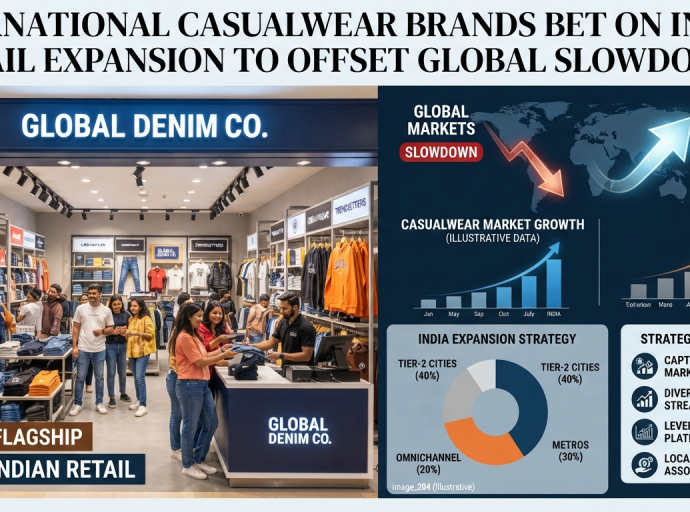
Global apparel licensors are increasingly relying on India’s organized retail expansion to counterbalance sluggish discretionary spending in Western and Middle Eastern markets. US Polo Assn. projects its Indian consumer sales to surpass Rs 4,000 crore in FY27, aiming to double domestic turnover within five years as part of a broader push toward $4 billion in worldwide revenue.

Operated locally by licensee Arvind Fashions, the brand is approaching 500 outlets across 180 cities and adding up to 70 stores annually, predominantly financed through franchise partners. To capture higher basket sizes, new outlets are doubling in floor area to 2,000 sq ft, while digital channels now contribute 30 percent of local sales - outpacing the brand's 25 per cent global online average through aggressive dark-store integration for 30-minute deliveries.

Managing input inflation through category diversification

While India represents the label's fastest-growing market globally, retailers face projected input cost increases of 4 per cent alongside intense competition from domestic direct-to-consumer challengers. India is helping drive global growth even as select international territories face headwinds, states J Michael Prince, President and CEO, USPA Global. To defend margins and reduce reliance on core menswear, the company is scaling footwear - now at three million pairs annually - alongside womenswear, denim, and kidswear, setting a benchmark for legacy international labels localizing supply chains in South Asia.

Expanding with franchise-led store additions and omnichannel retail

Established in 1890 as the official brand of the United States Polo Association, U.S. Polo Assn. markets casualwear, footwear, and accessories across 190 countries. Having entered India in 2009, it now ranks among the brand’s top three global territories, targeting 20 per cent annual domestic growth through franchise-led store additions and omnichannel expansion.

International casualwear brands bet on Indian retail expansion to offset global slowdowns

Underneat accelerates omnichannel push toward Rs 2,000 crore milestone

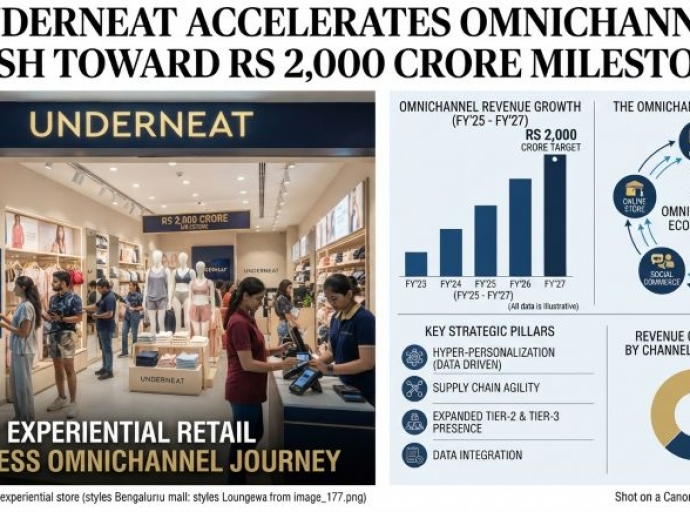
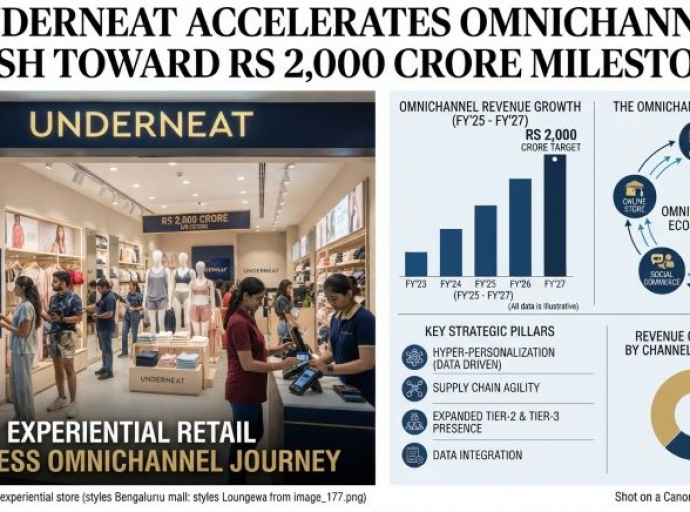
Homegrown innerwear and shapewear brand Underneat is expanding its physical retail footprint after reaching a Rs 450 crore annual recurring revenue (ARR) run rate within six months of its second operational year. The company plans to open 10 to 20 brick-and-mortar outlets next year across the National Capital Region, Bengaluru, and Mumbai, featuring 1,000–1,500 sq ft experience centres alongside compact 500–750 sq ft formats. Early offline trials indicate in-store average order values are nearly double the Rs 2,000 D2C benchmark, prompting discussions with investment bankers for a fresh capital raise to fund store rollouts and technology.

MUCH MORE

Profitable scaling amid sector competition

As global labels like Skims enter India through Reliance Brands, Underneat is balancing rapid expansion with fiscal discipline, maintaining a 5.5 per cent EBITDA margin while diversifying beyond core shapewear. Non-shapewear categories across its 65 SKUs now generate 60 per cent of revenue, boosted by quick commerce channels like Blinkit contributing up to 15 per cent of sales. Because we are growing at an exponential rate, we should keep our profitability close to last year's percentage, says Vimarsh Razdan, Co-founder and CEO, noting, repeat buyers already account for 35 per cent of business.

WATCH

Offering size-inclusive garments for Indian body types

Co-founded in 2025 by Kusha Kapila and Vimarsh Razdan, Underneat designs size-inclusive shapewear, wireless bras, and bodysuits tailored for Indian climates and body proportions. Operating across major metro markets via D2C, marketplaces, and quick commerce, the EBITDA-positive brand crossed Rs 100 crore in year one and projects Rs 2,000 crore in revenue by 2032.

Easitex-Textiles Sustainability

Underneat accelerates omnichannel push toward Rs 2,000 crore milestone

Botanical textiles gain commercial ground as luxury brand Jiwya launches new collectionpas

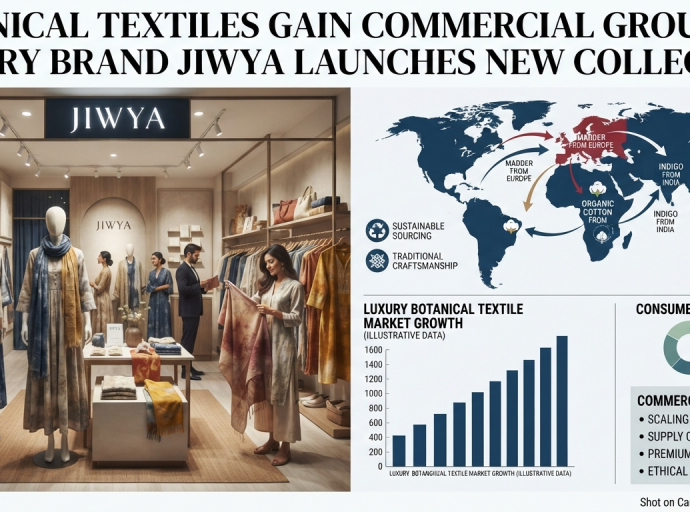
Luxury fashion houses are increasingly substituting synthetic blends with traceable, unbleached plant fibers to meet tightening global sustainability mandates. Marking its third operational year, Indian botanical fashion label Jiwya released its largest seasonal lineup, the 25-piece Aarsa Spring/Summer 2027 collection. The assortment integrates traditional handlooms such as Kota Doria, mulmul, and kala cotton alongside alt-tag cotton derived from agricultural waste and linters.

By retaining raw, unbleached kora yarns and eliminating synthetic dyes and plastic fasteners, the brand reduces water consumption by roughly 90 per cent compared to conventional textile processing. Priced between Rs 7,500 and Rs 19,800 domestically, the collection tests consumer appetite for zero-waste, made-to-order luxury that prioritizes supply-chain transparency over mass-market speed.

Balancing artisan lead times with global retail demand

While demand for verified eco-luxury continues to expand across international boutiques, scaling purely handcrafted production remains a structural challenge. Garments in the Aarsa line require up to 230 hours of manual construction, utilizing hand-stitched, glue-free glass mirror embellishments across 150 rural artisan clusters. Choosing unbleached fabrics and strictly plant-based inputs directly addresses water conservation and microplastic pollution in apparel manufacturing, states Aishwarya Lahariya, Co-Founder and Designer, Jiwya. As regulatory scrutiny on synthetic waste intensifies, material-first labels demonstrate how decentralized craft networks can supply high-margin resortwear without relying on petrochemical textiles.

Driving growth through high-margin artisanal collections

Founded in 2022 by two textile scientists in Nashik, Jiwya manufactures 100 per cent plant-based, biodegradable luxury apparel and home decor. Operating across domestic and international direct-to-consumer channels, the venture is expanding its made-to-order footprint following its maiden funding round and London Fashion Week debut, driving revenue through high-margin, zero-inventory artisanal collections.

Botanical textiles gain commercial ground as luxury brand Jiwya launches new collectionpas

Latest Publications

Image

Join Our Group

Join Our Group