
As 2026 rules tighten, fashion shifts circularity from esg promise to business strategy
24 April 2026, Mumbai
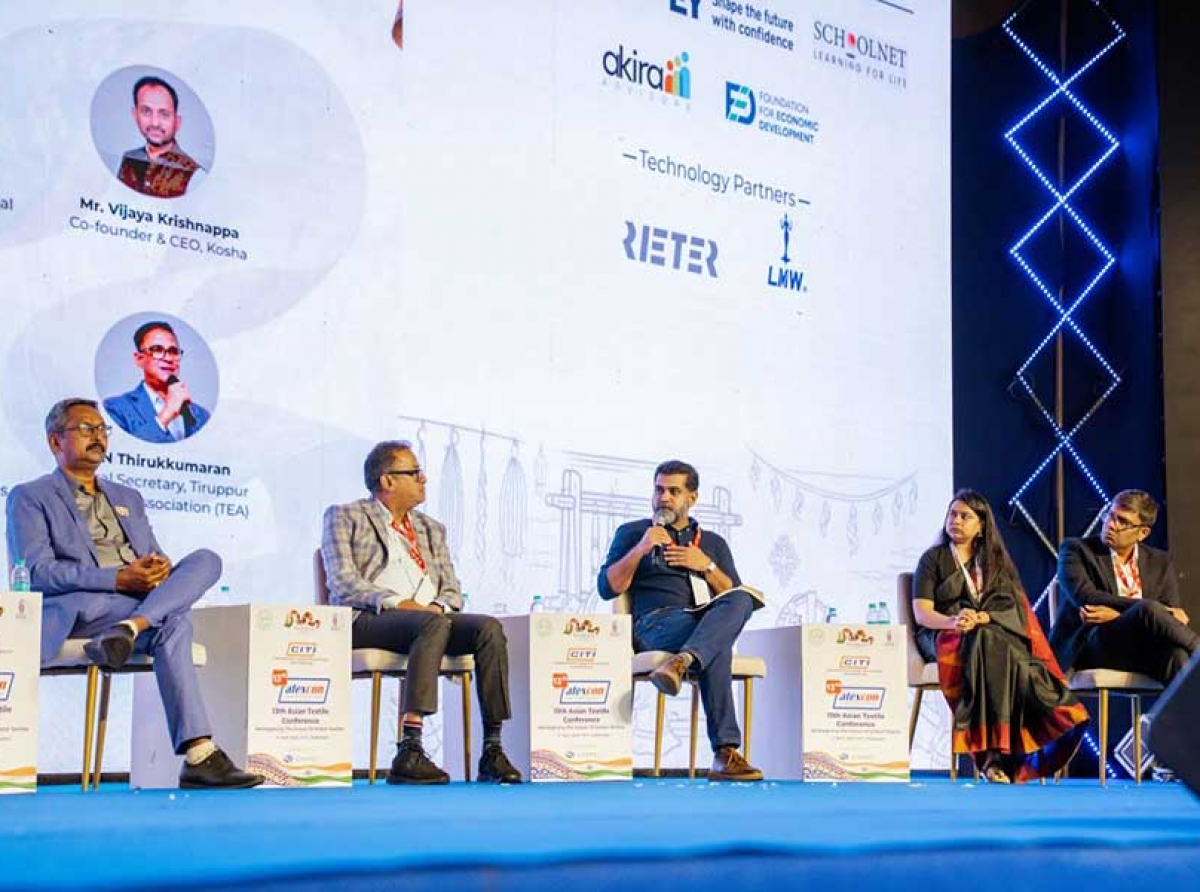
The global apparel sector is moving gear from a linear take-make-waste model to a high-stakes circular economy, as industry leaders at the recent TEXCON 2026 conference in Hyderabad declared that textile-to-textile recycling has moved beyond a sustainability goal into a commercial necessity. With the global textile recycling market projected to reach $1.7 billion this year and expected to touch $8.5 billion by 2035, the conversation has shifted from experimental pilots to the hard economics of scaling industrial infrastructure.
Regulatory pressure reshapes global supply chain
The urgency at TEXCON 2026 was underpinned by the imminent enforcement of the EU’s Ecodesign for Sustainable Products Regulation (ESPR) and expanded Extended Producer Responsibility (EPR) schemes. Starting this year, brands operating in Europe face stringent financial penalties for unsold inventory and must provide ‘Digital Product Passports’ to verify material origins. This regulatory hammer is forcing a redesign of global supply chains, particularly in manufacturing hubs like India and Vietnam. Stakeholders pointed out that waste is being rebranded as a resource, but only for those who have invested in the traceability systems required to prove circularity to customs officials and cautious investors.
Technical breakthroughs challenge 1% recycling ceiling
Despite the momentum, the industry faces a sobering reality: currently, less than 1 per cent of clothing waste is recycled back into new garments. However, 2026 marks a technical turning point with the commercialization of chemical depolymerization. Technologies like microwave-assisted glycolysis are now capable of breaking down complex polyester-cotton blends into virgin-quality monomers in under 15 minutes. Companies such as Loop Industries and Aquafil have scaled operations to process thousands of tons annually, effectively decoupling growth from virgin petroleum and cotton extraction. These advancements are essential for brands that have committed to using at least 50 per cent recycled fiber by the end of this fiscal year.
Economics of collection and infrastructure gap
While the technology for high-purity recycling exists, the commercial bottleneck remains the first mile collection and segregation. Experts emphasized that for circularity to be cost-effective, it must outperform the logistics of landfilling. The current infrastructure is fragmented, particularly in Asia, where only 13 per cent of textile waste is effectively diverted for reuse. The challenge for 2026 is moving toward ‘offtake’ agreements, where brands commit to long-term purchases of recycled materials to provide the financial security recyclers need to build multi-million dollar processing hubs.
Fashion for good: scaling sustainable innovation
Fashion for Good is a global innovation platform and Dutch-based social enterprise that acts as a bridge between sustainable startups and the traditional retail industry. Focused on apparel and textile manufacturing, the organization operates primarily in European and Asian markets to accelerate circular technologies. Having increased its reach significantly through 2025, the group now manages a portfolio of high-impact pilots aimed at zero-waste manufacturing. Financially, it banks on corporate partnerships with majors like H&M and Kering to de-risk green investments, maintaining a historical role as the sector’s primary engine for practical, scale-ready sustainability solutions.










 Get in Touch!
