
India's unbranded apparel market faces an organised retail challenge
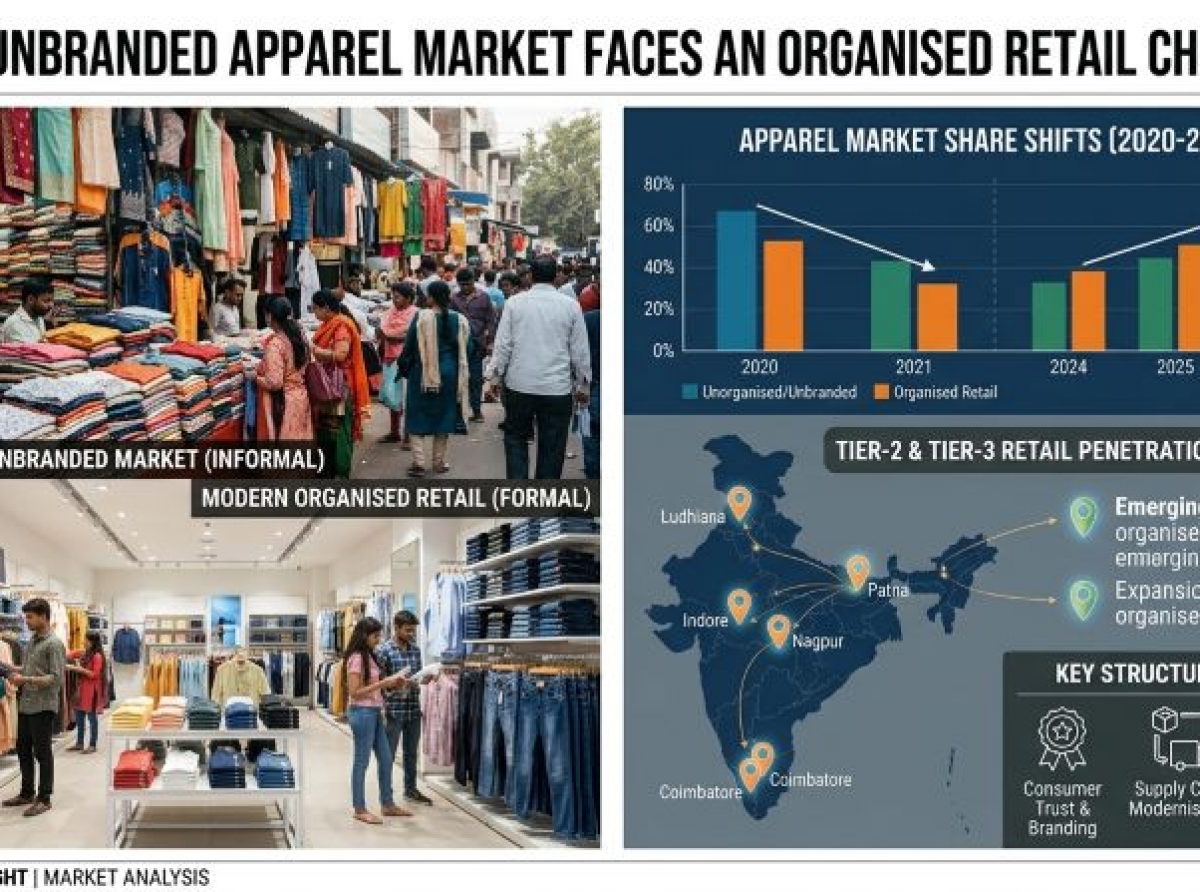
India's apparel retail market is at its most price-sensitive period. An estimated 59 per cent of the domestic market, worth approximately Rs 5.5 lakh crore, remains controlled by unorganised retailers, including weekly haats, regional trading hubs and neighbourhood shops, shows to CareEdge Ratings study. This largely unbranded segment is now becoming the next battleground for organised retail.
For years, branded apparel struggled to compete below Rs 500 because advertising, distribution and retail overheads made low-ticket products commercially unviable. That equation is changing. Affordable digital marketing, more efficient sourcing, tax rationalisation and expanding organised retail networks are lowering the cost of reaching consumers. The broader organised apparel market, valued at Rs 9.3 lakh crore, is projected to reach Rs 16 lakh crore by FY30. Value fashion is growing at over 12 per cent annually, creating an opportunity for organised players to capture consumers who have traditionally prioritised price over brand identity.
Three developments are catalysing this change. Smartphone-led marketing has reduced dependence on expensive mass-media advertising. The GST structure, with 5 per cent rate on apparel priced up to Rs 2,500 against 18 per cent above that threshold, supports the business of mass-market clothing. Meanwhile, organised sourcing and distribution are narrowing the cost advantage historically enjoyed by local traders.
The last-mile advantage
Distribution remains the biggest challenge in low-ticket apparel. A Rs 399 shirt sold through conventional e-commerce can incur Rs 60-Rs 80 in shipping costs, before accounting for reverse logistics and returns. With return rates reaching 25 per cent in some categories, the cost structure quickly turns unsustainable.
Hyperlocal fulfilment offers an alternative. By positioning inventory closer to consumers through neighbourhood dark stores, brands can reduce delivery distances and improve fulfilment economics. Quick-commerce platforms are emerging as additional distribution channels. According to Bain & Company and Flipkart, groceries and household essentials account for 85-90 per cent of quick-commerce gross merchandise value. Apparel, however, offers platforms an attractive opportunity because of its higher gross retail margins compared with packaged food.
More and more brands are exploring Zepto, Myntra's M-Now, Booon and Flipkart Minutes to distribute everyday clothing without building extensive regional delivery infrastructure. Utility shirts, workwear, chinos and basic knitwear are natural candidates for this model.
Competing for the value consumer
Organised retailers are pursuing the opportunity through different store formats, price patterns and distribution strategies.
Table: Value retail & fast-fashion brand comparison
|
Retailer/Brand |
Operating model |
Price positioning |
Operating benchmark |
Expansion strategy |
|
Trent (Zudio) |
Large-format stores |
80% of SKUs below Rs 999 |
Rs 16,300- 18,000 sales per sq. ft. |
Tier-II, III markets and fast-fashion turnover |
|
Reliance Retail (Yousta) |
Youth-focused stores |
High-density assortment below Rs 499 |
Target of over 1,000 stores |
Competing with regional value chains |
|
Shoppers Stop (InTune) |
Compact high-street outlets |
Rs 199-699 |
Rs 11,000 sales per sq. ft. |
Suburban markets |
|
V-Mart / V2 Retail |
Regional value department stores |
Family apparel largely below Rs 500 |
Rs 8,100-8,500 sales per sq. ft. |
Tier-II, IV markets in northern and eastern India |
|
FTX Fashion |
Quick-commerce distribution |
Commuter-focused apparel below Rs 499 |
Initial batches of 80-100 units |
Dark stores and urban delivery clusters |
Physical retail expansion is being led by established value-fashion operators. Trent's Zudio has showcased the potential of high inventory turnover, limited marketing expenditure and aggressive pricing. Reliance Retail is positioning Yousta against regional value chains, while Shoppers Stop is using InTune to address the affordable family-wear segment.
Smaller batches, faster replenishment
Expanding across physical stores and dark-store networks creates another challenge: inventory management. Dispersing stock across multiple locations without reliable demand signals can increase holding costs, lock up working capital and trigger markdowns. Consequently, agile manufacturing and smaller production runs are becoming central to the operating model. For example, FTX Fashion uses initial production batches of 80-100 units per design across platforms such as Zepto and Flipkart Minutes. Sales velocity is tracked across individual dark-store locations, with only around one in five designs qualifying for larger reorders.
This test-and-replenish model reduces exposure to unsold inventory and allows production to respond to actual consumer demand rather than seasonal forecasts. The objective is to keep dead stock below single-digit levels while maintaining faster cash conversion.
Durability becomes the differentiator
Winning the sub-₹500 consumer is not simply a pricing exercise. Redseer identifies value hunters as a key customer segment, comprising younger consumers and working households with annual incomes below ₹5 lakh.
For these buyers, affordability must translate into usable garment life. Frequent washing, daily commuting and intensive wear make fabric durability and construction important purchase considerations. Manufacturers are responding with heavier fabric constructions, poly-cotton and high-tensile poly-viscose blends, wrinkle-resistant finishes and darker colour palettes. Stitching strength, collar stability and wash performance are becoming critical product attributes.
As brand strategy specialist Harish Bijoor points out, consumers paying Rs 399 are not necessarily looking for disposable fashion. They expect garments to withstand repeated use. Poor construction can undermine repeat purchases, regardless of how attractive the initial price appears.
Organised market yest
India's unbranded apparel market is no longer protected by distribution barriers or the economics of conventional advertising. Organised retailers have the scale, sourcing capabilities and technology to compete at price points previously considered commercially unattractive. However, the transition will not be won through discounting alone. Low procurement costs, disciplined inventory management, efficient manufacturing, localised distribution and product durability must work together.
The opportunity is substantial, but the operating margins are unforgiving. The companies that can combine factory-floor efficiencies with high inventory turns and consistent product quality will be best positioned to convert India's Rs 5.5-lakh-crore unorganised apparel market into organised retail revenue.









 Get in Touch!

