
Premium ready-to-wear reshapes India’s luxury fashion market
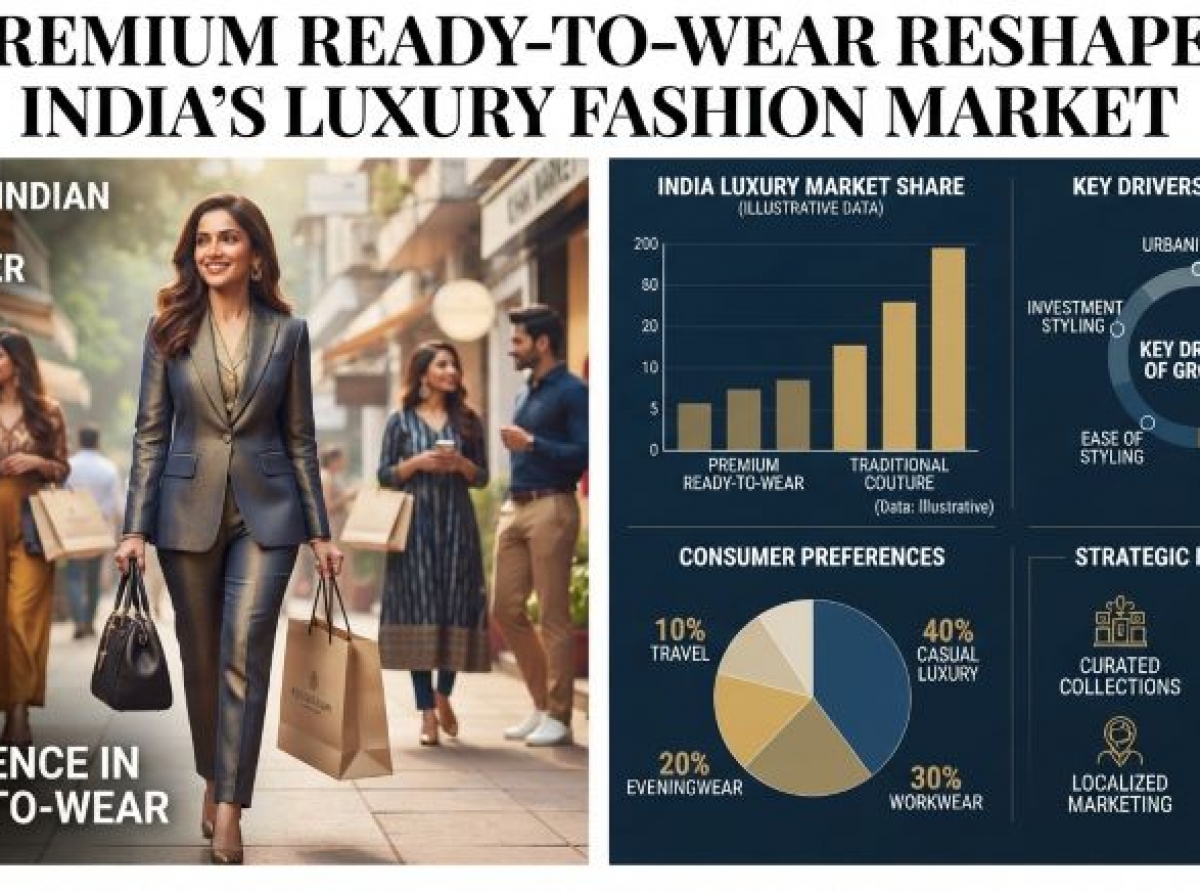
India’s luxury fashion market is shifting beyond its traditional dependence on bridal and occasion wear, with contemporary clothing, artisanal craftsmanship and cross-border digital commerce emerging as growth drivers. The opportunity is substantial, but converting heritage techniques into scalable businesses will require stronger supply chains, experiential retail and direct access to international consumers.
According to IMARC Group, the domestic luxury fashion market was valued at $9.85 billion in 2025 and is projected to reach $15.17 billion by 2034, at a compound annual growth rate (CAGR) of 4.92 per cent. The next phase of growth will depend on how effectively Indian fashion houses translate traditional skills into commercially viable products without diluting their craft identity.
A shifting market
Premiumisation is extending beyond wedding wardrobes into everyday luxury. Affluent consumers are seeking contemporary separates, refined silhouettes, natural textiles and distinctive construction rather than relying solely on conspicuous branding.
This shift creates an opportunity for domestic designers to build repeat-purchase categories around premium ready-to-wear, tailored clothing, stoles, capes and versatile occasion pieces. Instead of depending on seasonal wedding demand, brands can develop broader wardrobes that encourage more frequent purchases.
Clothing and apparel account for 61 per cent of the luxury fashion market, according to IMARC's estimates. Women's share is 52 per cent, reflecting the category's importance in discretionary fashion spending. North India contributes 30 per cent to the market, supported by purchasing power concentrated in Delhi-NCR and other affluent northern markets.
Table: Market and growth driverse
|
Market |
Benchmark |
Growth driver |
|
Market value, 2025 |
$9.85 bn |
Rising affluent consumer base |
|
Projected value, 2034 |
$15.17 bn |
Premiumisation and wider geographic demand |
|
CAGR, 2026–2034 |
4.92% |
Contemporary luxury and international expansion |
|
Clothing and apparel |
61% |
Premium ready-to-wear and designer separates |
|
Store-based distribution |
70% |
Physical evaluation and personalised service |
|
North India's market share |
30% |
Concentrated regional purchasing power |
|
Women's wear |
52% |
Expanding discretionary wardrobe spending |
Source: IMARC Group. Figures reflect the supplied market estimates.
Retail sells craft
Digital platforms influence discovery, but physical retail remains central to luxury conversion. Estimates show, store-based distribution accounts for 70 per cent of the market, underlining the importance of tactile evaluation and personalised selling. For products involving handloom fabrics, natural silks, intricate embroidery and specialist finishing, customers often need to assess texture, construction and detailing before committing to a high-value purchase. Luxury stores are therefore evolving from inventory-led outlets into experiential salons where product knowledge and storytelling support the sale. As Sanchit Anand, Founder of luxury apparel house Taroob points out customers are not buying a shawl; they are buying the hands and the hours behind it. Once you explain the technique, the price stops being a question.
The commercial implication is clear: craftsmanship must be communicated, not merely displayed. Explaining the provenance of a textile, the time required to execute an embroidery technique and the skill involved in finishing can help justify premium pricing.
For emerging labels, informed clienteling can strengthen conversion, support higher transaction values and build repeat business. Physical retail also provides an opportunity to introduce customers to complementary products, extending purchases beyond individual statement pieces.
Exports go direct
Cross-border e-commerce offers Indian luxury labels a route beyond domestic demand and traditional distributor-led expansion. Direct-to-consumer exports can connect brands with affluent Indian diaspora communities and international customers interested in distinctive textiles and artisanal products.
The model also gives brands greater control over customer relationships, product presentation and pricing than conventional wholesale arrangements may allow. International sales can diversify revenue and reduce dependence on domestic retail cycles, although the actual margin advantage will depend on logistics, duties, returns and customer acquisition costs.
The Directorate General of Foreign Trade has introduced measures intended to facilitate e-commerce exports, including digital processes for export realisation and designated E-Commerce Export Hubs. Electronic Bank Realisation Certificates (e-BRCs) support digital reconciliation of export proceeds, while courier-export procedures and evolving export frameworks can reduce administrative friction.
For labels targeting the Gulf Cooperation Council (GCC), the UK and North America, these mechanisms can improve the viability of smaller, direct international shipments. However, brands still need reliable fulfilment, transparent delivery timelines, destination-market compliance and manageable reverse-logistics costs.
The opportunity lies in building global demand before committing to expensive overseas store networks. Digital channels can test product-market fit, identify high-performing categories and establish customer relationships that may eventually support physical expansion.
Scale without dilution
The most important challenge is operational. Handcrafted production is fragmented across artisan communities, making it difficult to guarantee consistent quality, colour matching, output volumes and delivery schedules. These limitations become more pronounced when a label moves from bespoke orders to repeat retail collections or international wholesale commitments. Delays in yarn procurement, dyeing and specialist handwork can disrupt replenishment and erode margins.
The solution is not to mechanise every stage. Brands need to separate processes that benefit from standardisation from those that depend on individual skill. Cutting, grading, base stitching and selected finishing operations can be centralised in organised production units. Embroidery, brocade weaving and specialist embellishment can remain within village-level artisan networks, preserving the techniques that distinguish the product.
Digital manufacturing execution systems and inventory-planning tools can improve visibility across distributed production. Tracking yarn allocation, loom output, work-in-progress and finished inventory can help brands coordinate orders without imposing industrial uniformity on inherently specialised work. This hybrid model offers a practical route to scale: standardise the operating system, not the craftsmanship.
Taroob's playbook
Founded in 2021, Taroob showcases how a craft-led label can build a contemporary luxury proposition around traditional Kashmiri techniques. Its portfolio includes artisanal stoles, capes, heritage accessories and bespoke occasion wear, combining traditional craftsmanship with modern silhouettes.
The brand serves metro luxury markets and Tier-I cities through boutiques and omnichannel platforms. Its stated ambition to expand into the GCC and Western markets reflects a wider opportunity for Indian labels to take regionally rooted craftsmanship to international consumers.
Taroob's model rests on direct artisan networks and the translation of heritage techniques into products suited to contemporary wardrobes. Sustaining growth, however, will depend on consistent quality, production planning, customer retention and the economics of overseas fulfilment.
The next frontier
India's luxury fashion opportunity is not simply about selling more expensive clothing. It is about turning craft provenance into a repeatable commercial advantage. The projected $15.17 billion market offers room for brands that balance contemporary design with credible craftsmanship, combine digital discovery with physical retail and build export channels without losing control of product quality.
The winners will be those that make heritage commercially accessible without making it generic. Craft may create differentiation, but disciplined execution will determine whether that differentiation can support lasting scale.









 Get in Touch!

