
Sportswear manufacturing gains pace as global brands localise India supply chains
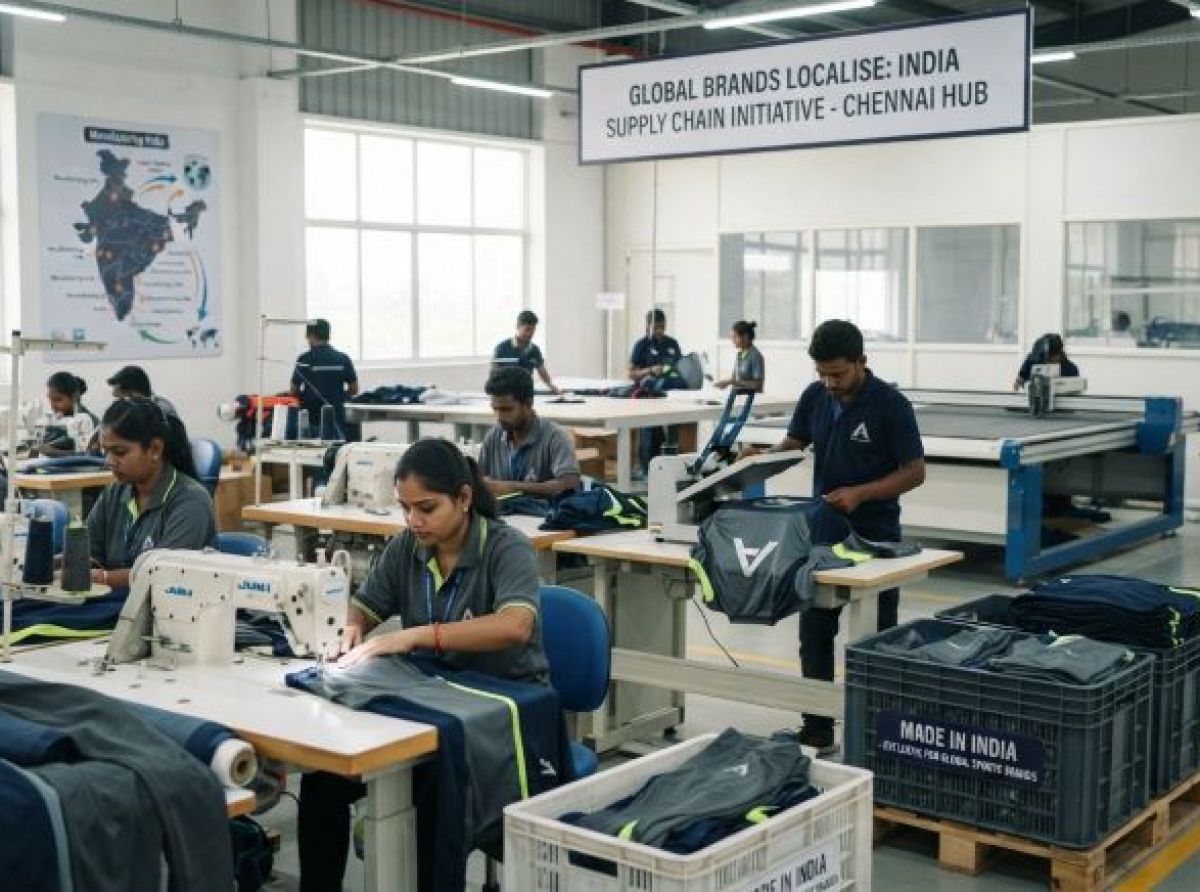
India is emerging as a strategic manufacturing and consumption market for global sportswear brands as they rethink sourcing, pricing and retail expansion. Nike, ASICS and Decathlon are strengthening their domestic operations through local production, differentiated product portfolios and direct consumer engagement, positioning India as both a growth market and an alternative sourcing base.
The shift comes as global sportswear companies confront margin pressures in mature markets and prolonged weakness in Greater China. India, supported by rising fitness participation, expanding contract manufacturing capabilities and growing demand for performance apparel, offers an opportunity to diversify supply chains while tapping a rapidly expanding consumer base.
According to KPMG India, the country's sports economy is valued at approximately $19 billion and is projected to reach $40 billion by 2030, growing at an annual rate of 12-14 per cent. Within this, sports goods, apparel and equipment manufacturing is estimated at $6.7 billion, with the potential to reach $10 billion by the end of the decade.
Fitness boosts demand
The manufacturing opportunity is closely linked to changing consumption patterns. Running, recreational athletics and performance fitness are moving beyond niche urban activities to become mainstream consumption categories.
Decathlon Sports India estimates that India hosted approximately 2,000 organised running events in 2025, compared to 500-600 in 2018. The expansion of running communities and amateur sporting events is creating demand for technical apparel, compression layers, moisture-wicking synthetic fabrics and specialised footwear. IMARC Group values India's running gear market at $2.7 billion in 2026, against $2.5 billion in 2025, and projects it to reach $4.9 billion by 2034.
This shift is significant for India's textile manufacturing clusters. Tiruppur, Surat and Ludhiana, traditionally associated with conventional knitwear and apparel production, have an opportunity to move up the value chain through technical fabrics, synthetic blends, performance garments and specialised construction. Unlike basic cotton knitwear, performance products require advanced fabric engineering, functional finishes and tighter quality controls, creating opportunities for manufacturers to secure higher-value orders.
Two distinct price patterns
Global brands are also adopting different pricing strategies to address India's expanding but highly segmented sportswear market. Nike's India-developed Vegam Run running shoe, priced at Rs 3,795 on Flipkart, shows its attempt to reach entry-level runners through locally engineered products. Developed in approximately five months, the shoe reflects a more targeted approach to product development and pricing.
The strategy comes as Nike faces business pressures across the world, particularly in Greater China, where sales have declined for nine consecutive quarters. Weakness in its Jordan and lifestyle divisions has added to the pressure, increasing the importance of markets that offer opportunities for volume growth and product localisation.
ASICS, meanwhile, is pursuing the premium performance segment. The Japanese brand is targeting annual top-line growth of up to 35 per cent over five years and aims to establish leadership in India's high-end running footwear market by 2029. With footwear prices ranging from Rs 3,999 to Rs 29,999, ASICS reported approximately 30 per cent sales growth in 2025, reaching 12 billion yen, or around $76 million. Its 138-store network recorded 15 per cent same-store sales growth.
The brand's presence at running events is central to its expansion strategy. ASICS accounted for nearly one-third of the footwear worn at the 2025 Tata Mumbai Marathon and has partnered with the Freshworks Chennai Marathon scheduled for January 2027.
The contrast is clear: Nike is pursuing a wider entry-level opportunity through local product development, while ASICS is building its premium positioning around specialised performance and running communities.
Sourcing moves in-house
The more consequential shift, however, is taking place within manufacturing. Import duties on finished footwear and apparel, combined with global supply-chain diversification, are encouraging international brands to increase domestic sourcing. India is gradually moving from being primarily a consumption market to becoming a production base for global sportswear companies.
ASICS currently sources 30 per cent of its footwear domestically and plans to increase this to 40 per cent over the next three years. Decathlon has committed €100 million towards strengthening its Indian manufacturing operations, with domestic facilities already accounting for 50 per cent of its footwear unit volume.
These investments are creating demand for specialised manufacturing capabilities, including automated high-frequency welding, EVA injection moulding, recycled polymer weaving and technical textile processing.
For Indian manufacturers, the opportunity extends beyond conventional cut-and-sew operations. Global sourcing programmes require consistency in materials, product engineering, performance testing and production scalability. Suppliers able to meet these requirements stand to gain from the shift towards local procurement.
The proposed India-European Union Free Trade Agreement could further strengthen the opportunity by improving access to European markets for technically advanced sportswear and equipment manufactured in India.
Decathlon builds scale
Decathlon is the best example of how manufacturing, retail and product development can operate as an integrated growth model. The French sporting goods retailer reported operating revenue in FY25 revenue of Rs 4,133.10 crore and has set a target of RS 10,000 crore by FY30. It currently operates 132 stores in India and plans to expand its network to 200 outlets by the end of the decade. With retail expansion, the company is increasing its focus on specialised sporting categories and institutional sales to schools, educational facilities and athletic academies.
Its running business has become a significant growth driver. Through KIPRUN, its technical running sub-brand, Decathlon has introduced 35 performance products, including 17 footwear models. These include the carbon-plated KIPSTORM ELITE 2 and cushioned KIPRIDE MAX.
Chief executive Sankar Chatterjee says, the running business generates nearly Rs 500 crore annually, with a target to exceed Rs 1,000 crore within four years. Domestic assembly and local material sourcing are expected to support this expansion.
|
Market indicator |
Current baseline |
Growth target |
Growth driver |
|
Indian sports economy |
$19 bn (2025-26) |
$40 bn by 2030 |
Fitness participation, institutional sports, and infrastructure |
|
Sports goods, apparel, and equipment manufacturing |
$6.7 bn |
$10 bn by 2030 |
Local sourcing, investment, and export opportunities |
|
Indian running gear market |
$2.7 bn (2026) |
$4.9 bn by 2034 |
Running culture and technical activewear |
|
Decathlon India revenue |
Rs 4,133.10 cr (FY25) |
Rs 10,000 cr by FY30 |
Store expansion and domestic manufacturing |
|
ASICS India sales |
12 bn yen (2025) |
Up to 35% annual growth |
Premium footwear and local sourcing |
Moving up the value chain
India's sportswear opportunity is no longer confined to rising domestic consumption. The convergence of global brand investments, technical textile capabilities and growing manufacturing infrastructure is creating the conditions for a more integrated athletic goods ecosystem.
However, reaching the $10 billion manufacturing target will require more than additional production capacity. Indian suppliers must invest in specialised machinery, advanced synthetic materials, product development, testing and compliance with international sourcing standards.
The next phase of growth will depend on whether domestic manufacturers can move beyond contract production into higher-value technical components and finished performance products. For global brands, India offers a combination of manufacturing diversification and long-term consumer growth. For domestic suppliers, the opportunity is to secure a larger role in the global sportswear value chain rather than remain confined to low-margin assembly.










 Get in Touch!

