
Festive demand, store expansion give Indian apparel retail an edge over global markets
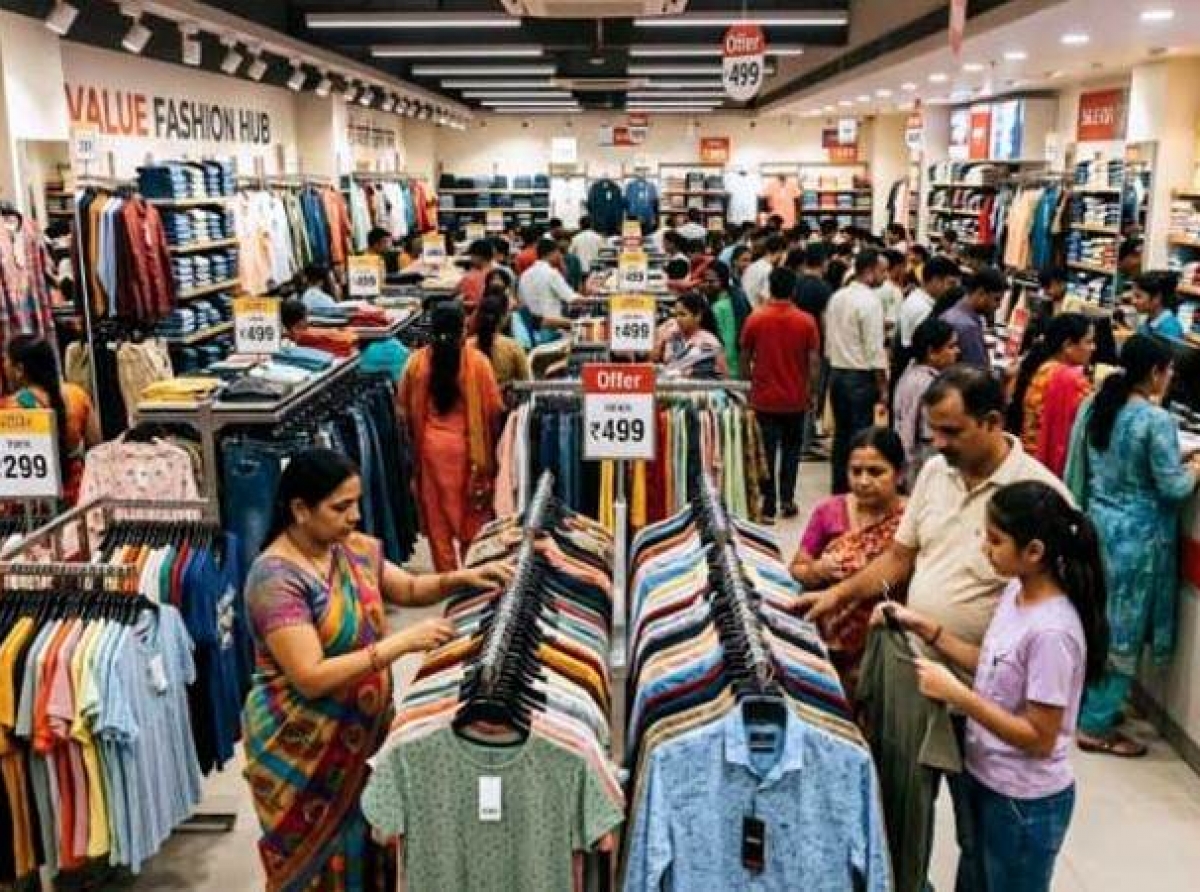
India’s apparel retail market is entering the festive season with a consumer-confidence advantage that sets it apart from major global markets. The September Ipsos ‘Global Consumer Confidence Index’ indicates India’s confidence index rising 1.6 points to 66.9, close to its July peak of 67.1 and the highest reading among the 30 economies tracked.
The contrast with global markets is stark. The global average remained unchanged at 48.4, while the benchmark for established economies stood at 46.2. The US was at 50.5, Great Britain at 48.0, Germany at 41.6 and Japan at 39.4. Only India and Sweden, at 60, crossed the 60-point expansion threshold. For Indian apparel retailers, the timing is particularly significant. The September-to-December period covers Durga Puja, Diwali and the winter wedding season, traditionally one of the most important consumption windows of the year.
Confidence creates a festive tailwind
The underlying indicators strengthen the case for a consumption-led festive quarter. India’s employment sub-index jumped 3.7 points in September, while the current personal financial conditions measure rose 2.4 points. Investment and purchasing-climate indicators also recorded gains.
This matters because apparel is particularly sensitive to discretionary confidence. Improved perceptions of employment and household finances can shift consumers from essential replacement purchases towards occasion wear, premium fashion, accessories and higher-value baskets. The festive period could therefore favour brands able to sustain full-price sales rather than relying heavily on promotions.
Table: Highlights of global consumer confidence index
|
Market/Region |
September Index Score |
1-month trend |
Impact on fashion & retail |
|
India |
66.9 |
+1.6 pts |
Aggressive flagship openings, full-price sell-through, festive stock build |
|
Sweden |
60 |
+3.5 pts |
Selective Nordic recovery; modest demand rebound in apparel |
|
US |
50.5 |
Flat |
Promotional discounting, cautious inventory commitments, margin defense |
|
Great Britain |
48 |
+0.4 pts |
Footfall rationalization, mid-market store closures, channel shifting |
|
Germany |
41.6 |
-0.6 pts |
Severe discretionary cutbacks, high markdown exposure |
|
Global Benchmark (30 Countries) |
48.4 |
Unchanged (0.0) |
Defensive merchandising, supply chain consolidation |
Source: Ipsos Global Consumer Confidence Index
Store expansion moves beyond metros
The confidence difference is also feeding into retailers’ physical expansion strategies. While fashion retailers in mature Western markets remain focused on rationalising store networks and protecting margins, India continues to offer room for additional retail penetration.
Prime shopping-centre space in Delhi-NCR, Mumbai and Bengaluru remains competitive, but Tier-II, III cities are becoming more important to the next phase of organised apparel expansion. Cities like Lucknow, Chandigarh, Ahmedabad and Kochi are attracting modern retail formats as consumers move towards branded and organised fashion. Reliance Retail, Aditya Birla Fashion and Retail and Tata Group’s Trent are among the large domestic players expanding across value, mid-market and aspirational segments.
The physical-store strategy also reflects changing strategy in fashion retail. Higher digital customer-acquisition costs have put pressure on online profits, while strategically located stores can generate stronger transaction values and offer consumers the immediacy and experience associated with fashion purchases.
Premium demand meets value-segment caution
The positive consumer background, however, does not imply uniform demand across the apparel market. Premium, aspirational and occasion-wear categories are better positioned to benefit from festive spending, while parts of the deep-value and unbranded market continue to face weaker volume conditions. This makes assortment planning critical.
Retailers that overstock basic mass-market merchandise could face higher post-festive markdown risks. At the same time, cotton yarn, synthetic inputs and logistics costs remain sources of margin pressure. Aggressive price increases could undermine the very demand momentum retailers are seeking to capture.
Consequently, shorter vendor lead times, tighter replenishment cycles and greater localisation of supply chains are becoming important tools for protecting gross margins.
Zara model highlights store productivity
The India performance of the Inditex-Trent retail partnership show the opportunity presented by a confident urban consumer. Zara’s positioning in prime retail locations combines frequent assortment refreshes with rapid replenishment, allowing stores to respond quickly to changing demand.
The broader lesson for apparel retailers is that India’s opportunity is not simply about adding stores. It is increasingly about extracting higher productivity from each retail door through sharper assortment, faster inventory turns and reduced dependence on markdowns.
Trent’s portfolio offers a broader example of this strategy. Westside and Zudio formats span lifestyle and value fashion, while its partnerships with Inditex bring Zara and Massimo Dutti into the Indian market. The group’s continuing expansion across metros and emerging urban centres reflects the depth of India’s organised fashion opportunity.
Festive quarter tests retail discipline
India enters the festive cycle with a consumer-confidence cushion that is unusual in the current global environment. But translating confidence into profitable growth will depend on how retailers manage inventory, pricing and store productivity.
For apparel companies, the opportunity is therefore two-sided: capture consumers willing to spend more, while avoiding excessive inventory commitments in weaker value segments. If the September confidence gains translate into sustained purchasing activity through Diwali and the wedding season, Indian apparel retail could widen its growth divergence from mature international markets. The festive season will ultimately test whether strong consumer sentiment can convert into sustained full-price sales, higher productivity and healthier retail margins.










 Get in Touch!
