
CMAI Rolls Out Multi-Pronged Industry Roadmap: Sourcing platforms, sustainable circularity, AI forecasting, and credit safeguards
During an extensive media interaction convened at its newly acquired permanent headquarters in Mumbai, the Clothing Manufacturers Association of India (CMAI) detailed an expansive blueprint of industry-facing initiatives, skilling drives, and forthcoming business platforms designed to strengthen domestic apparel manufacturing. Addressing industry correspondents, CMAI President Santosh Katariya noted that the transition from rented facilities to an association-owned headquarters marks a key operational milestone in executing the body’s "Mission 2028" strategic agenda.
Moving beyond its foundational consumption benchmarking research, the leadership team outlined targeted interventions aimed at resolving critical structural bottlenecks across the apparel supply chain. These measures encompass corporate vendor sourcing linkages, circular economy incubation, institutional legal dispute resolution, and accessible artificial intelligence-driven fashion forecasting tailored for micro, small, and medium enterprises (MSMEs).
Bridging factory floors and corporate buyer desks
Connecting domestic apparel producers with organized retail corporations remains a historic operating hurdle for regional manufacturing units. To bridge this divide, CMAI confirmed the scheduled rollout of its dedicated Vendor Sourcing Fair 2.0 in 2027.
The initiative is designed to establish direct commercial channels between small-to-mid-scale garment manufacturers and tier-one corporate procurement divisions, including volume retail networks such as Zudio and Reliance Retail. By creating a curated, vetted discovery forum, the platform allows private-label producers and white-label manufacturing units across the country to secure reliable, long-term sourcing contracts without facing traditional institutional entry barriers.
Circularity In Practice: Textile waste incubation and artisan integration
Addressing environmental compliance and industrial sustainability, the association highlighted its operational work under the EcoStitch and Environmental, Social, and Governance (ESG) committees. Partnering with the School of Fashion Technology (SOFT) in Pune, CMAI has supported research and incubation centers over the past six years to develop commercially viable post-consumer textile recycling models.
Circularity discussions focused on resolving practical operational bottlenecks, particularly landfill redirection, garment segregation, chemical enzyme decomposition, and the technological challenges of recovering blended fabrics back into usable yarn and fiber stages. Industry panellists identified institutional uniform collections—such as school and corporate uniforms,as prime starting points for closed-loop recycling due to standardized fabric compositions, while exploring emerging alternative fibers derived from bamboo and agricultural residues like orange pulp.
Complementing technical recycling, CMAI continues its association with Green Fashion India (GFI), an initiative supported by Maharshi Karve Stree Shikshan Samstha. The program brings traditional textile artisans from dispersed handcraft clusters, including Kutch and Kolkata, directly into commercial brand supply networks, providing sustainable livelihoods and integrating heritage artisan techniques with contemporary industrial design.
Additionally, CMAI confirmed its participation in the upcoming Mumbai Climate Week in February 2027, organized in partnership with the Brihanmumbai Municipal Corporation (BMC). The association has been approached to lead the textile and apparel track for the multi-industry sustainability summit, following senior-level ministerial engagements.
Split Execution and Trade Scale: National Garment Fair 2027
To manage record participation volumes and ongoing infrastructure upgrades at the NESCO Bombay Exhibition Centre in Goregaon, CMAI has restructured the 2027 Summer edition of the National Garment Fair (NGF) into a bifurcated exhibition model spanning two separate schedules.
The Men’s, Kids’, and Accessories Fair will lead the calendar from February 1 to 3, 2027, occupying approximately 290,000 square feet of floor space with 650 participating brands and suppliers. This will be immediately followed by the Women’s Wear Fair from February 8 to 10, 2027, which will cover nearly 150,000 square feet of exhibition area with 300 participating brands.
Collectively, this dual-phase arrangement aggregates around 1,000 participating apparel brands across an unprecedented total exhibition footprint of close to 450,000 square feet, solidifying the NGF’s position as the domestic industry's primary order-booking event for summer retail assortments.
Upstream Textile Sourcing and Enterprise Technology: The FAB Show
At the upstream textile level, the association announced the 7th edition of the FAB Show, set for April 26 to 28 at the Jio World Convention Centre in Mumbai. Designed to facilitate raw-material sourcing across fabrics, accessories, trims, textile printing, machinery, and garment-tech software, the forthcoming edition will place a targeted focus on enterprise technologies and artificial intelligence applications to help domestic manufacturers upgrade operational throughput.
The platform builds directly on the momentum of its preceding edition, which brought together more than 300 exhibitors and 14,000 buyers. The event continues to attract organized delegations from nationwide manufacturing clusters; including Tirupur, Surat, Ludhiana, Bhilwara, Ichalkaranji, Erode, Noida, Delhi, and Jaipur, alongside international buyer delegations representing more than 27 countries. Concurrently, the fair will host the EcoStitch sustainability conference, CEO roundtables, and sourcing buyer-seller meets catering to private labels, buying houses, and retail corporates.
Democratizing Fashion Forecasting: Masterclasses with NIFT VisionNxt
To ensure regional manufacturers are not priced out of global trend forecasting, CMAI has finalized an agreement with the National Institute of Fashion Technology (NIFT) and its "VisionNxt" trend intelligence initiative, backed by the Ministry of Textiles. Because advanced commercial trend platforms often entail cost structures prohibitive for MSME garment units, the initiative leverages indigenous trend mapping and artificial intelligence tools to deliver regionalized season-ahead forecasts.
CMAI will conduct intensive three-hour forecasting masterclasses across key domestic garment clusters in three strategic regional legs. The first leg will focus on the western corridor, covering Ahmedabad, Surat, and Mumbai, before moving to southern industrial hubs including Tirupur and Bengaluru in the second phase. The outreach will culminate in a third leg targeting major northern and eastern manufacturing centers across Noida, Jaipur, and Kolkata.
Complementing these off-site clinics, CMAI’s newly inaugurated headquarters will house a specialized physical fashion library and digital podcast studio. The library provides direct access to expensive international trend periodicals, technical manufacturing manuals, and trade databases. The facility will host monthly podcasts and educational sessions under the association’s Achievers Club, alongside corporate masterclasses for visiting industry delegates.
Industrial Skilling Hubs and Capital Protection frameworks
Addressing widespread shop-floor talent shortages across the garment manufacturing sector, CMAI detailed the footprint of its Apparel Training Center (ATC) network. Operating from the Asmita Textile Park in Bhiwandi alongside decentralized centers in Ichalkaranji, Shahapur, Jalgaon, and Bhusawal, the facility has trained 650 operators in specialized sewing and production-line assembly under central skill initiatives, with an additional 650 candidates currently enrolled. The Bhiwandi unit also runs specialized industrial embroidery tracks, training women operators for export units and multinational manufacturers.
To mitigate counterparty commercial default risks, the association reported notable progress under its conciliation and credit settlement mechanism, active since 2010. Handling between 50 and 500 trade dispute filings annually, the dispute cell recovers between INR 3.5 crore and INR 4 crore in disputed receivables every year, taking total institutional recoveries past INR 27 crore.
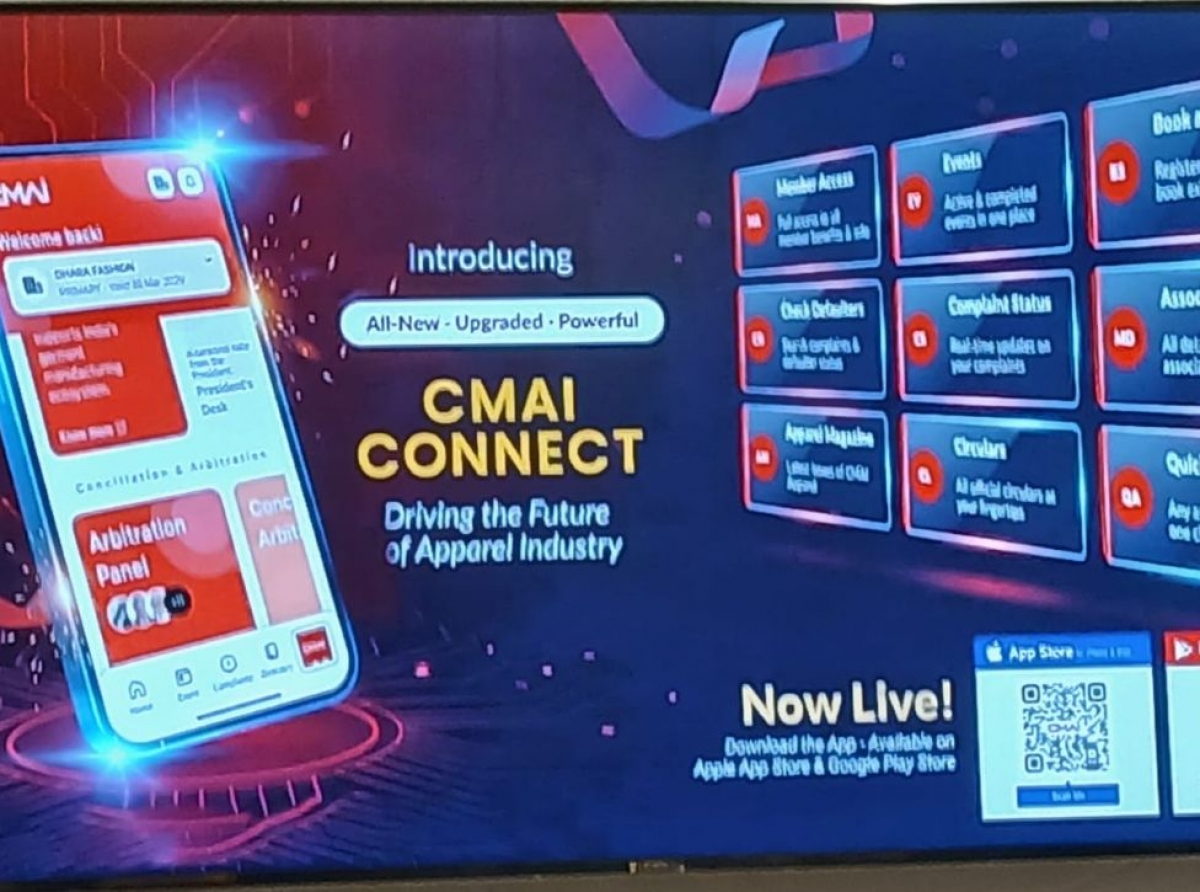
These credit protections are further strengthened through the newly launched "CMAI Connect" enterprise mobile application, which provides registered manufacturers with a verified retailer credit caution list to inform order acceptance and payment terms. Legally, the association has operationalized formal institutional arbitration rules; standard supply contracts incorporating CMAI arbitration clauses have successfully defended member claims, with recent awards upheld in High Court proceedings.
Through this coordinated focus on production linkages, shop-floor skilling, accessible design forecasting, and receivable risk management, CMAI is systematically addressing operational friction points across the apparel value chain, supporting balanced, long-term expansion across the domestic garment trade.









 Get in Touch!
