
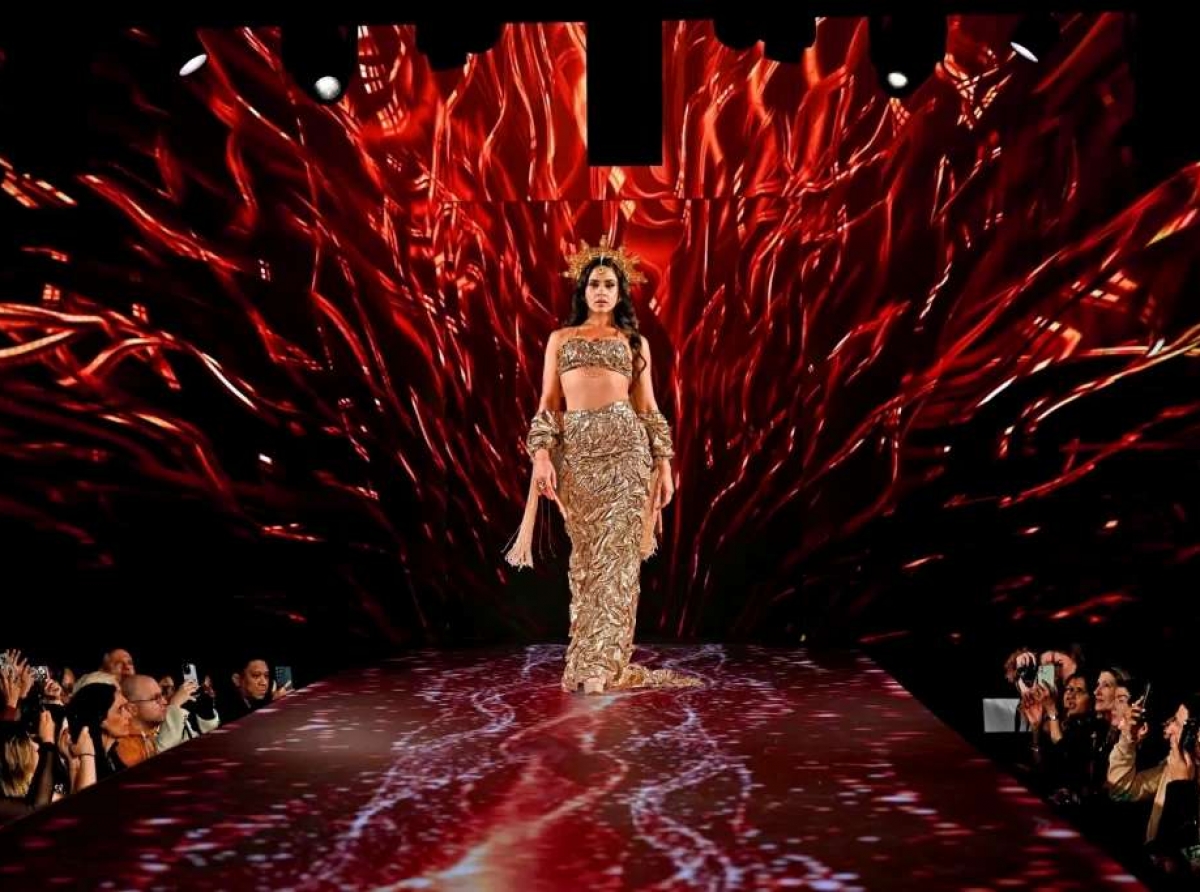
For decades, Indian craftsmanship powered Western luxury from behind the scenes. Hand embroidery, beadwork, textiles and artisanal techniques produced in Indian workshops frequently entered Parisian couture houses and Manhattan ateliers without the Indian origin being visible to consumers.
That equation is changing. The latest New York Fashion Week (NYFW) showcased a growing cohort of Indian and South Asian designers presenting their own brands directly to international buyers, luxury consumers and retail scouts. The shift marks a move from being an invisible supplier of craftsmanship to capturing the brand equity and retail value attached to that craftsmanship.
From supplier to brand
The change was visible across NYFW, with South Asian bridal label Nazranaa presenting its collections, including architectural velvet looks worn by Bollywood actor Bhumi Pednekar, while Prashant Goyal’s Heritage India Fashions put Indian heritage techniques into a contemporary luxury context.
The significance goes beyond runway visibility. Designers are increasingly translating regional textile traditions, artisanal embroidery, Vedic geometries and ceremonial techniques into luxury separates, occasion wear and commercially viable collections rather than positioning Indian design simply as ethnic fashion. The result is a more direct proposition for global consumers: Indian craftsmanship, but sold under an Indian brand name and at international luxury price points.
Sabyasachi changes the equation
The most visible expression of this transition came from couturier Sabyasachi Mukherjee, who returned to the official CFDA NYFW calendar after two decades with ‘Bengal Byzantine Broadway’. The collection also marked a multi-year partnership with The Metropolitan Museum of Art. Through the museum’s licensing programme, Sabyasachi drew on five millennia of art history, incorporating references to antiquities and Byzantine heritage into handcrafted high jewellery produced in India using Jaipur gemstones and indigenous goldsmithing traditions.
The commercial importance of the collaboration lies in the positioning. Rather than adapting Indian aesthetics to fit an established Western luxury vocabulary, the collection placed Bengal, Byzantine influences and Broadway within the same cultural conversation. That approach potentially changes how Indian luxury is marketed internationally: not as an interpretation of Western heritage, but as a source of heritage in its own right.
Diaspora creates demand
The expansion is also supported by the purchasing power of the Indian diaspora in North America. Weddings, fine jewellery and occasion wear have created a substantial premium-consumption ecosystem, with affluent customers increasingly able to purchase directly from Indian-origin luxury houses rather than through middle-tier distributors.
International fashion weeks therefore serve a commercial function beyond brand awareness. A runway presentation can become a customer-acquisition channel for high-value bespoke orders and overseas flagship sales. Luxury ensembles displayed in New York can command prices ranging from about $4,000 to more than $15,000, depending on craftsmanship, customisation and category. As Radhika Mehra, a retail merchandising consultant specialising in cross-border luxury apparel explains the runway is no longer an artistic indulgence; it is a direct channel for building international brand equity and securing custom high-margin orders.
Retail follows the runway
Brand visibility is being converted into physical retail presence. Sabyasachi’s 16,000-sq. ft. New York flagship in the West Village is a good example of an Indian luxury house establishing a permanent presence in a major global fashion market. Nazranaa has built an extensive showroom presence in New Jersey, giving it a physical base in the important East Coast bridal market.
Other Indian and South Asian labels are using trunk shows, department-store relationships and selective wholesale placements to test international demand before committing to permanent stores.
This reflects an evolution from exporting garments. The objective is to establish a complete retail ecosystem covering brand experience, customer relationships, bespoke services and repeat purchases.
Capital enables scale
Institutional capital is reinforcing the transition. Indian conglomerates such as Reliance Brands Limited (RBL) and Aditya Birla Fashion and Retail Ltd (ABFRL), which have interests in prominent designer labels including Sabyasachi, Manish Malhotra and Tarun Tahiliani, can give the financial and operational infrastructure required for international expansion.
For luxury houses, that backing can support overseas legal structures, inventory, logistics, flagship stores, experiential retail and category extensions without forcing designers to compromise their positioning for short-term volume. The opportunity extends beyond apparel. High jewellery, accessories, fragrances and home products can create additional revenue streams while reducing dependence on seasonal bridal and occasion-wear demand.
Craftsmanship is the highlight
India's artisanal Radhika Mehra, a retail merchandising consultant specialising in cross-border luxury apparel remains the industry's strongest asset. With over 2,000 documented craft clusters and extensive networks of master weavers and karigars, the country possesses capabilities that are difficult to replicate at industrial scale. That becomes relevant as global luxury consumers place greater emphasis on provenance, craftsmanship and cultural authenticity.
However, international expansion also brings constraints. Brands must manage higher logistics costs, Western sizing requirements, international fulfilment and the complexity of producing bespoke garments in India for customers overseas.
More importantly, occasion wear alone cannot provide the replenishment cycle required for a global luxury business. Ready-to-wear, accessories and lifestyle categories will need to develop alongside couture and bridal collections.
The significance of India's New York moment ultimately lies in value capture. Indian workshops have long supplied some of the world's most prestigious fashion houses with specialised craftsmanship. The emerging model allows Indian designers to retain more of the value chain from design authorship and storytelling to branding, retail and direct consumer relationships.
The transition is therefore not simply about greater visibility at fashion week. It signals an attempt by Indian luxury houses to move from being the craftsmanship behind global luxury to becoming the global luxury proposition themselves.









 Get in Touch!
